The Hemp Rug Pull: Who Wants What and What Comes Next
By Mark Vuozzo, CTO, PurBlend Science, Inc. | Opinion | October 2026
Listen to this article
Choose a version to listen to

On December 11, a federal rule is scheduled to take effect that will decide whether most hemp-derived products stay legal in the United States. I run a company that makes full-spectrum hemp products, so I have a stake in this, and you should know that before you read another word. This is an opinion piece. I have tried to keep what happened separate from what I think about it, and I have linked the sources so you can check my work.
The short version: hemp has been legal since 2018. The FDA never wrote workable rules for the products that followed. In November 2025, Congress tried to deal with the resulting mess using a blunt cap, and that cap would take most of those products off the market. The White House has publicly urged Congress to fix it. So far, Congress has only delayed it, and the new deadline falls on the same day the government’s temporary funding runs out.
Where things stand today
The restrictions were supposed to start November 12. President Trump signed a delay on September 2, after the Senate voted 61 to 32 to table Senator Ted Budd’s amendment to keep the original date and the House passed the delay 370 to 48. The new start date is December 11, the same day the government’s stopgap funding runs out. The law itself has not changed. Only the clock has.
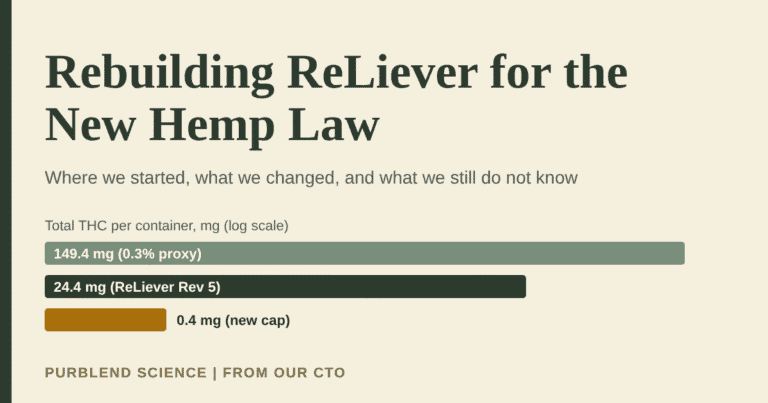
Since 2018, hemp has been defined as cannabis with no more than 0.3% delta-9 THC. The law Congress passed last November changes that in two ways. It counts total THC, which includes THCA, a compound that is not intoxicating on its own but converts to THC when heated. And it bars finished products that contain more than 0.4 milligrams of total THC per container.
That is a tiny number. A single container often holds many servings. The U.S. Hemp Roundtable estimates the new definition would disqualify roughly 95 percent of current hemp cannabinoid products. A September report from Whitney Economics, which surveyed hemp operators in 35 states, projects that if the rules take effect, retail revenue would fall by about $28.3 billion, roughly 225,000 jobs would be displaced, and most current products would disappear. The report covers hemp-derived cannabinoids generally, including non-intoxicating CBD, and it does not say who commissioned it, so treat the numbers as an industry projection, not a settled fact.
The video the President shared
On the evening of September 28, 2025, President Trump shared a short video on Truth Social. It was produced by the Commonwealth Project, a group founded by Howard Kessler that advocates for hemp-derived CBD for older Americans. The video is about two and a half minutes long, and the President does not speak in it. It argues that older adults are already using CBD, that doctors lack guidance, that there are no FDA standards for the products on the market, and that Medicare should cover it. It closes by asking him to make this part of his legacy. The group posted it on its own site on October 3.
I think the video matters for two reasons, and I want to be fair about both. First, whatever you think of the claims in an advocacy video, the President chose to share it. Seven months later he posted his own message asking Congress to fix the hemp law, and his administration’s policy statement said much the same. That is a government saying, out loud, that it wants these products to stay available. Second, the people who made it are not neutral. The Indianapolis Business Journal reported that Kessler’s funding comes from a company that trademarked a line of CBD gummies for seniors, and that he is an acquaintance of the President. Researchers it quoted cautioned that the science is behind the marketing, that the only FDA-approved CBD medicine is for childhood epilepsy, and that CBD can interact with prescription drugs, which matters for older adults taking several.
I take the video for what it is: an advocacy piece that shows what the White House has been willing to promote. Imagine how much better this could go if the government got out of the way and wrote rules instead of bans.
The argument in USA Today
On September 8, USA Today ran an opinion piece by Maddie Salamone and Caitlin Styrsky of the Pacific Legal Foundation, a group that advocates for access. Their central point is that federal policy contradicts itself: Medicare is piloting coverage of hemp-derived CBD while Congress moves to remove those same products from the market.
They make four arguments worth understanding. First, use is widespread. They cite surveys suggesting a majority of adults have tried CBD, and note that older adults, including many Medicare enrollees, are a large share of users. Second, the legal mechanics are harsher than they look. Because the new law counts total THC, including THCA, the authors say it effectively criminalizes the raw plant material used to make CBD even when a finished product has no detectable THC, which is how they say even creams and gummies could be caught. Third, the 0.4 milligram cap per container is hard to meet when containers hold several servings. Fourth, states that built regulated hemp markets would watch federal action override them.
Their ask is modest. If Congress cannot pass real reform in time, extend the deadline and study how hemp is actually used. And keep federal policy consistent, so that products Medicare is willing to cover, with up to 3 milligrams of THC per serving, are not made illegal. They end by saying Washington can either catch up to the role CBD plays in American life or stand in the way of the medical freedom of millions of voters. Remember that they are advocates, and that I cannot independently verify every number they cite.
The other side
The opposing case deserves its strongest form, not a caricature.
Safety and children. Senator Budd argues intoxicating hemp products pose real risks to consumers, especially kids, and he has said he will keep pushing for prohibition after the midterms. Thirty-five state and territory attorneys general urged Congress not to reverse the ban. The concern is real: the market has included high-dose THC gummies, synthetic cannabinoids, and products with unclear labels. The FDA itself has warned about mislabeled products.
Authority and evidence. Smart Approaches to Marijuana sued to stop the Medicare pilot, arguing that CMS lacks the authority to allow access to these products without clearer direction from Congress, and that the products lack FDA approval. Researchers have noted that evidence for many CBD uses is thin, and that the studies we have are small.
A libertarian objection. Jeffrey Singer, writing for the Cato Institute, criticizes both sides at once. He argues Medicare coverage would raise prices and add paperwork for a product already sold over the counter, and that Congress’s THC cap would make CBD production uneconomical because extracting CBD also concentrates THC. In his view, the right fix is repealing the cap, not medicalizing the market.
I do not think the safety concern is made up. I think it is being used to justify a rule that reaches far past it.
What I think
The government failed first. Since 2018, the FDA has not stepped in with workable regulation, which left the industry to run on best practices. Some companies took those seriously. Others used the gap to undermine what best practices even mean. That vacuum created much of the controversy we are living in now. The FDA’s approval of a single CBD drug in 2018 also gave it a legal reason to keep CBD out of food and supplements, and in my view that handed the agency a convenient reason to wait instead of write rules. That was another mistake at the beginning.
A one-size-fits-all cap is the wrong tool. The market has grown into drinks, edibles, especially gummies, and topicals, which is where I am heavily invested. These are different products with different risks. Lawmakers are trying to solve all of them with one number. I read the 0.4 milligram cap as a trigger meant to force Congress to finally act. I cannot show that was the intent, and nothing I found says so, but that is how it looks to me. Since then, a whole stack of bills has been introduced to bring clarity. That is what a trigger produces.
Look at who benefits from the fight. This has become a political football because there is money in it. Full-spectrum hemp competes with much bigger industries: pharmaceuticals, the health aisles of every drugstore, alcohol at a moment when people are drinking less and low-dose hemp drinks look like a replacement, and the licensed cannabis industry, which pays heavy taxes under heavy regulation and would rather control THC itself. I am describing incentives, not accusing anyone of bad faith. But when you see the same fight in so many places, follow the money.
It was built wrong from the start. Hemp began as an industrial crop. Then the medicinal and wellness uses arrived, and now both are threatened unless Congress gives us a clear definition.
Here is what I think should replace the cap. Rather than an arbitrary number, even the 0.3 percent figure from 2018, regulators should study a ratio of CBD to THC in the product. There is some interesting chemistry here, since CBD at high doses affects how the liver processes other compounds, THC included. But the honest truth is that this has been studied far too little, and the one controlled trial I found, a small Johns Hopkins study published in JAMA Network Open, found that a very large dose of CBD alongside THC raised THC levels and made the effects stronger, not weaker. That is exactly why the FDA’s failure to run real studies is the problem. My suggestion, and it is only a suggestion for regulators to test, is something like 15 parts CBD to 1 part THC as a starting point. It would give everyone a lane to operate in, especially the medicinal side of the industry. It may need to go higher than that.
And a personal observation. I have never seen anyone get high from putting a cream on their skin, no matter how much THC was in it. That is my observation, not a legal or medical claim, but it tells me the rules should treat a cream and a gummy differently.
I expect change, and I expect damage in the meantime. Lawmakers rarely do the right thing on their own schedule, so I do not expect it here. What worries me is the collateral damage while they decide. If nothing changes by December 11, a large part of this industry will be shut down or left with no legal pathway to sell its products. When the light was finally shining on this industry, a gray market will form anyway, one way or another, because people want these products. A gray market is the worst outcome for everybody: no testing, no labels, no accountability.
What happens next
Here is the part that gives me some hope, and it is a matter of mechanics, not politics. December 11 is not just a hemp deadline. It is the day the government’s temporary funding expires, so Congress has to pass something by then, either a new stopgap or full-year spending bills, or the government shuts down. The hemp restrictions are already attached to that same funding track. They first rode in on the bill that ended last fall’s 43-day shutdown, and the September delay rode in on a stopgap. A delay that needs a special act of its own is a long shot. A delay that can be added to a bill that already has to move is a much easier lift. That is not a promise, and it is not a fix: Senator Budd opposes any further delay, a White House staffer was reportedly telling Senate Republicans there would be no more, and Congress has let shutdowns happen before. But if you want to know where the realistic window is, it is the funding bill.
Congress has until December 11. The options are another delay folded into the next spending bill, a real framework such as the Barr and Craig bill, or letting the ban start. A senior White House staffer reportedly told Senate Republicans there would be no further delays, though that has not been made formal. Senator Budd says he will press for a ban once the midterms are over. The FDA was required to publish a list of cannabinoids the plant can naturally produce and a definition of a container by February, and as of early September it had not.
For our part, we are doing what we can. We have been reformulating products to meet the new law, and early results look encouraging, though that does not guarantee anything. We will go by what is on the books, and we will keep applying the PBX Standard to whatever comes. I will tell you plainly when I know more.
A word from me
When I step back from the bills, the votes and the deadlines, here is what I see. In a recent survey of 1,523 American adults, about 35 percent said they have used CBD, and more than seventy percent of those said they used it for therapeutic reasons such as pain or anxiety. By my arithmetic that is tens of millions of people, not tens of thousands. I believe full-spectrum, hemp-derived CBD has earned a lawful place in the lives of the people who choose it, and I hear from many of them. I am not making a medical claim, and these statements have not been evaluated by the FDA. I am telling you what I believe.
Anything that helps people has a way of being criminalized first. We are only now coming out of prohibition, and just as we do, it threatens established businesses. I believe this has little to do with the health and concerns of the people, and I think the people in the way should step aside. That is a bigger issue than one blog post can settle.
I thought government was supposed to be for the people, by the people. It does not always feel that way, and the people who make and use these products keep getting the short end of the stick. I hope Congress proves me wrong before December 11.
God bless everybody.
Sources
- Cannabis Business Times: Trump promotes hemp-derived CBD for senior health care in shared video
- Indianapolis Business Journal: Trump posts video endorsing CBD for seniors; researchers urge caution
- The Commonwealth Project: the video page
- The Commonwealth Project: the video itself (TCP-2.mp4)
- NORML: Trump calls on Congress to loosen federal restrictions on hemp-derived CBD
- Colorado Politics: Trump calls for Congress to amend hemp ban
- Pacific Legal Foundation (USA Today op-ed, Sept. 8, 2026): Medicare now covers CBD, but Congress wants to ban it
- High Times: Trump signs hemp ban delay; the new deadline is the day funding runs out
- Forbes: Trump signs bill delaying hemp THC ban until December
- High Times: Hemp ban hidden inside government shutdown bill; McConnell backed the move
- GovInfo: H.R. 9830, Lawful Hemp Protection Act
- Cannabis Business Times: S. 3686, Hemp Planting Predictability Act
- Whitney Economics: U.S. hemp cannabinoid report for 2026
- GreenState: lawsuit against the Medicare CBD pilot
- Cato Institute (Jeffrey Singer): Rescheduling isn’t enough, and Medicare could make CBD worse
- JAMA Network Open: randomized crossover trial of THC with and without CBD
- GreenState: how many Americans use CBD (Journal of Cannabis Research survey, 1,523 adults)
- Brookings: the Farm Bill, hemp and CBD explainer
These statements have not been evaluated by the Food and Drug Administration. This product is not intended to diagnose, treat, cure, or prevent any disease. This article is the author’s opinion and is not medical, legal, or financial advice.